One irony in the “free speech” movement

One irony in the “free speech” movement that has emerged from the terrorist attack on the Hebdo office in Paris is how much the US media omits.

The United States, of course, funded and armed al-Qaida back in the Reagan years to counter Russian influence in Afghanistan. In addition, the US has had a long term “special relationship” with Saudi Arabia, the principal supporter of radical Islam in the world. 15 of the 19 hijackers in the 9/11 attacks came from Saudi Arabia. 

Our media also left out a key piece of information about the last horrific terrorist attack based on radical ideology, the slaughter of 77 mostly teenagers by Anders Breivik in Norway. The students had been gunned down because they were supporters of Palestinian rights, and the crazed gunman was inspired by Islamophobia and right-wing Zionism.

Maybe any religion that supports violent killings in he name of God should be condemned, be it Muslim, Christian, or Jewish. Maybe governments should be condemned as well. The US should end its support for Saudi Arabia, a country that monthly beheads more in the name of Islam than IS does in a year. Then there is our government’s embrace of Israel while it slaughtered 500 Palestinian children in Gaza. President Obama even rushed additional high tech bombs to the Israeli Army in case there were more UN schools to be obliterated. 


Let’s not cover up the truth in our newly found enthusiasm for free speech.

Fred Nagel

Article in La Voz Magazine

Thanks, Fanny, for the translation.

THE LAST GAZA WAR AND THE HISTORY OF THE ISRAELI-PALESTINE CONFLICT
By  Rosana Zarza Canova

Surely, may read in the newspapers or listen on the radio about the Gaza conflict that happened this summer, june 7 to august 26.  It started after 2 young Israelis were kidnapped and killed, on june 12,
Near Bethlehem, in Cisjordania, and a young Palestinian guy was assassinated on july 2 in east Jerusalem.

The office of humanitarian issues of the occupied territories in Palestine (OCHA opt) informs that 1.8 million people were affected in Gaza.  11,231 people were injured, and 2,231 died.  Israel had 71 dead.
OCHA also informs that 37.650 houses were damaged and 18,000 were destroyed in Gaza.  A humanitarian
Catastrophe.

When I spoke with my family, friends and co-workers about this event, I was angry when they suggested
That it had been a war.  I don’t believe that this last offensive has been a war.  The language that is 
Usually used about the Israeli-palestinian conflict is important: war is quite different than conflict and
Offensive.  This conflict has to be observed in order to understand that the events that just happened
Were not of a war.  Newspapers and radio news usually don’t have enough space or time to put the
Actual events in its right historical context.

It has to start by knowing dates, 1917, 1948, 1967 and 2000, y words like Zionism, Nakba, arab nationalism to understand the conflict.  On November 2nd of 1917, the Balfour declaration was
Enacted.  Arthur James Balfour, the ministry of exterior of England, send a letter to the president of the
Zionist federation, giving him his support to create a jewish state in Palestine.  Zionism is a movement
Created to re-establish a piece of land for the jews in the land of Israel.  Palestine had been administrated by the English after the first world war.  In 1947 the united nations declared a partition
Plan for Palestine en two estates- jewish and arab.

1947 and 1948 an Israeli-arab war ensued between Israel and Egypt, Syria, Jordan, Saudi Arabia, Irak and
Libia.  In 1948 Israel was declared a jewish state and the English left Palestine.  The Nakba, which is considered the arab catastrophe was when 900,000 palestinians had to flee or were expelled from their
Homes in what today is Israel.  My family, friends and co-workers should know about this history, in order to be able to comment regarding the actual event. Aljazeera.com, is a source known for its news
And history of the middle east, and tells how Israel took another 50% of the declared partition of the United Nations.

The six day war happened in 1967, and then Israel took Cisjordania of Jordan, Gaza and the Sinai peninsula from Egypt, and the Golan Heights from Syria.  The map, common in studies of this conflict, shows how Israel has been extending itself on the Palestinian territory from 1946 to 2011.  From the first world war to the present the Palestinian territory, and therefore, its politics and government, have
Been dominated by the english, Israelis or the arabs, and not by the Palestinians.  The organization to liberate Palestine (OLP) was started by the League of Arab Nations in 1964.  This league is comprised by the arab nations.  Arab nationalism started to be formed after the second world war mostly in Cairo (Egypt) and the OLP was started by Egyptians and not Palestinians.  Rashid Khalidi, teacher of arab studies Columbia University, suggests that the arab nationalism and the arab league undermined the
Palestinian nationalistic movement.  

After reading the history of the Israeli-Palestinian conflict I hope my family, friends and co-workers will not continue calling the recent offensive or conflict in Gaza, a war. The actual events cannot be understood without the context of its history, but only as a part of a long history, complicated and intense.  Palestinians do not have the capacity to make decisions for themselves since long time ago, 
Due to the fact that before the English, the Ottoman empire were governing.  Israel controls the Gaza
Strip and Cisjordania since l967.  It is called an Occupation.  During the last offensive, the secretary of
The United Nations, Ban Ki-Moon, ask a stop to the firing and said that there should be a way to end
This Occupation.  Also there is a lot of history to understand besides of the events that happened in 1917, 1948, 1967 and 2000.  For example, the failure of the peace process, the wall that separated 
Israel the west bank and Gaza, the history of Hamas, which is the party governing Gaza, and the blockade of Gaza.

About the Author

Rosana Zarza-Canova is the daughter of an Spanish father and a North-American mother.  She graduated from Bard College in May of 2014 majoring on Politics Science and Arab studies.  She is intense on the Israeli-Palestinian conflict.  She stopped working for La Voz at Bard so that she could establish a project together with her Palestinian friend, called the Bard Palestinian Youth Initiative.  This project brings Bard students to a town in the west bank, summer time, as a cultural interchange, and to develop resources for young people.  January 2015 she is starting her new service to the community with youngsters and the Peace Corps in Morocco.    
  
Resources to Learn more About the Israeli-Palestinian Conflict

After summer of horror, Gaza families face winter in cramped shacks “Electronic Intifada.” October 17, 2014.  http://electronicintifada,net/content/after-summer-horror-gaza-families-face-winter-cramped-shacks/13952

Khalidi, Rashid.  Palestinian Identity: the Construction of Modern National Consciousness. New York: Columbia UP, 1997.

Gaza in cridital conditions,” says Ban, calling again for immediate ceasefire”  UN News Centre.  July 28, 2014.  http://www.un.org/apps/news/story.asp?NewsID=48357#.VEkru1arE3Y

Timeline: Palestine since 1915” AlJazeera. February1, 2009.

“Occupied Palestinian Territory: Gaza Emergency Humanitarian Snapshot” OCHA oPt. September 4, 2014. http://www.ochaopt.org/documents/humanitarian_snapshot_8september_2014-opt_v4.pdf

The “civilized” American people will be forever linked with the fate of the Palestinians.

Since World War II, America has been coming to terms with the Nazi Holocaust. How did a “civilized” German people commit such atrocities? Did they know of the extermination camps, or recognize the criminal insanity of their leaders?

How could they not have known? The decade before the war had been filled with the most hateful expressions of racial persecution. Millions of Germans participated in the beatings, the destruction of businesses, and the looting of homes. So very few spoke out against the impending genocide. Were they led astray by a blind, messianic nationalism? Were they simply scared to raise their voice against what had become a repressive military dictatorship?

All the time we have been studying someone else’s holocaust, reading about it, watching movies, and building monuments and museums, we have been silently involved in our very own. Perhaps we were more inclined to look the other way, since our nation was built on the ethnic cleansing of indigenous populations and the exploitation of millions of black slaves.

Whatever the reason, we have been blind to the ethnic cleansing and impending genocide of the Palestinian people. We have allowed five million Palestinians to suffer under apartheid while another six million were forced from their homeland. We have defended Israel against against worldwide condemnation, supplied it with high tech weaponry, and given it billions in US aid. Moreover, our Congress approves each new slaughter in Gaza, insuring that the “civilized” American people will be forever linked with the fate of the Palestinians.


Fred Nagel

A Few Words Are Worth a Thousands Images

A Few Words Are Worth a Thousands Images
by Harriet Malinowitz

As people in towns and cities around the nation – including Ithaca, New York, where I live – explode over the second non-indictment of a white police officer who killed a black man in little over a week, many have remarked upon the resemblance between violent, racist repression here and in Israel/Palestine – and on the impunity enjoyed by those who represent the “law” in both places. According to the Israeli human rights and information organization B’tselem, from 2001 to 2011, the Military Police Investigations Unit “did not conduct investigations on Palestinians killed by Israeli soldiers.” Since then, those responsible for beatings and abuse “are not fully prosecuted. A new law passed by the Knesset, the Israeli parliament, makes it almost impossible for Palestinians wronged by Israeli security forces to claim compensation.”

The parallels become less surprising when one considers programs such as the Law Enforcement Exchange Program (LEEP), a creation of the Jewish Institute of National Security Affairs (JINSA), whose motto is “Securing America, Strengthening Israel.” Delegations of U.S. law enforcement officials – including “police commanders, security experts, and FBI agents” from LA, Chicago, DC, Boston, Philadelphia, New York, St. Louis, and other cities – are sponsored by JINSA and the Anti-Defamation League to learn Israeli methods of surveillance, intercepting “illegal immigrants,” crowd control, and other “counter-terrorism” and “law enforcement” measures that are conducted upon the people for, so it is said, their own protection.

Of course, U.S. authorities were not strangers to repressive tactics before this. As journalist Mark LeVine has pointed out, urban police departments and the federal government found counterinsurgency methods used in Vietnam to be useful in responding to the civil rights, anti-war, and United Farm Workers labor rights movements at home in the 1960s. And comparisons don’t imply equivalencies. Says LeVine, “Israelis are still living in the American 1950s, while Gazans remain trapped in a ghetto in which no Ferguson resident would want to live.” Still, Jimmy Johnson has reported in Electronic Intifada that in 2005, “the then-chief of police of Washington, DC, a city that has adopted Israeli-style policing to an extreme degree, told The Washington Post that Israel is ‘the Harvard of antiterrorism.’”

In Israel/Palestine, as in the U.S., the buck spent on surveillance – or at least its value - stops when it comes to cops. On May 15, 2014 – the anniversary of the Nakba, or the “catastrophe” in which hundreds of thousands of Palestinians fled or were killed in the 1948 war – two Palestinian teenagers were shot to death by Israeli police. According to CNN, “Security cameras captured the second fatal shooting that day of … 17-year-old Mohammad Odeh Salameh…. Doctors pronounced Salameh dead on arrival at the hospital, with a bullet wound that had pierced his back and exited his chest. No arrests were made….” An American-Israeli blogger not only denies the responsibility of the Israeli killers; he suggests that the video footage was simply a “’Pallywood’ production,” a “hoax in which no one was actually killed.”

Meanwhile, it’s the videotaping messengers who fare the worst. Ramsey Orta, the 22-year-old who captured Eric Garner’s death on his cell phone, was subsequently indicted – also in Staten Island - for weapons possession. Orta told the arresting officers, "You're just mad because I filmed your boy.” Strangely, his grand jury did not find him as credible as Daniel Pantaleo’s grand jury, of the same borough, found Eric Garner’s killer. “Karma’s a bitch” Orta’s arresting officer allegedly counseled him. Ira McKinley, director of the recent documentary The Throwaways (about mass incarceration and police brutality in upstate New York), was aggressively accosted by police for filming as they stopped a young black man near a community center in Albany, soon after Trayvon Martin’s murder. (He felt that some footage might be helpful.) When McKinley was arrested in Ithaca in 1989 – before cellphone cameras – the Ithaca Journal headlines ran “Differing Views” and “Two Versions Cloud Charge of Brutality.” Meanwhile, the routine fate of devices that record assaults on Palestinians (and their owners) is best summed up by the title of the documentary Five Broken Cameras.

As each graphic record hits the headlines – from Rodney King to Mohammad Odeh Salameh to the carnage in Gaza this summer to Eric Garner – those here and there who cling to a sliver of faith in justice believe that a tipping point has been reached, that after this, it can’t go on. But a few words from PR firms, think tanks, and prosecutors whose livelihood hinges on their complicity with police forces are apparently worth a thousand images.

This work is licensed under a Creative Commons Attribution-Share Alike 3.0 License

Harriet Malinowitz is Lecturer in Writing at Ithaca College and a member of Jewish Voice for Peace.
On Dec 10, at 3:01 PM Dec 10, 'Harriet Malinowitz' hmalinowitz@yahoo.com [MiddleEastCrisisResponse] <MiddleEastCrisisResponse@yahoogroups.com> wrote:
http://www.commondreams.org/views/2014/12/07/few-words-are-worth-thousands-images

The oppressor deflecting attention

Our guide helped us settle in the back of the large, black cab. Not any black cab, of course. These were special cabs brought to Belfast, Northern Ireland by the Catholic minority during the late 1960’s, when Protestant drivers routinely discriminated against them. Over 15 Catholic cab drivers were killed during the “Troubles” for trying to provide transportation for members of their embattled minority. 

The police force (Royal Ulster Constabulary) was no help at all, being almost 100% Protestant and predisposed to look the other way when Catholics were beaten or shot. 

“I am going to give you a special tour,” our guide said as we headed off. When I asked why, he told me it was my Palestinian bracelet. “If you know about Palestine, you will understand the Troubles in Northern Ireland.”

The first of the huge murals he drove us to was of Frederick Douglass, with depictions of slave ships, Sojourner Truth, Harriet Tubman, Rosa Parks, Barack Obama, Martin Luther King, Angela Davis, Nelson Mandela, Muhammad Ali, and Bob Marley. 


The Catholics of Northern Ireland had studied many African American writers in charting their own nonviolent resistance to racism and oppression. Our guide, a Catholic who had lived through the decades of often violent, state sponsored discrimination, even know what was in MLK’s Riverside Church speech. 

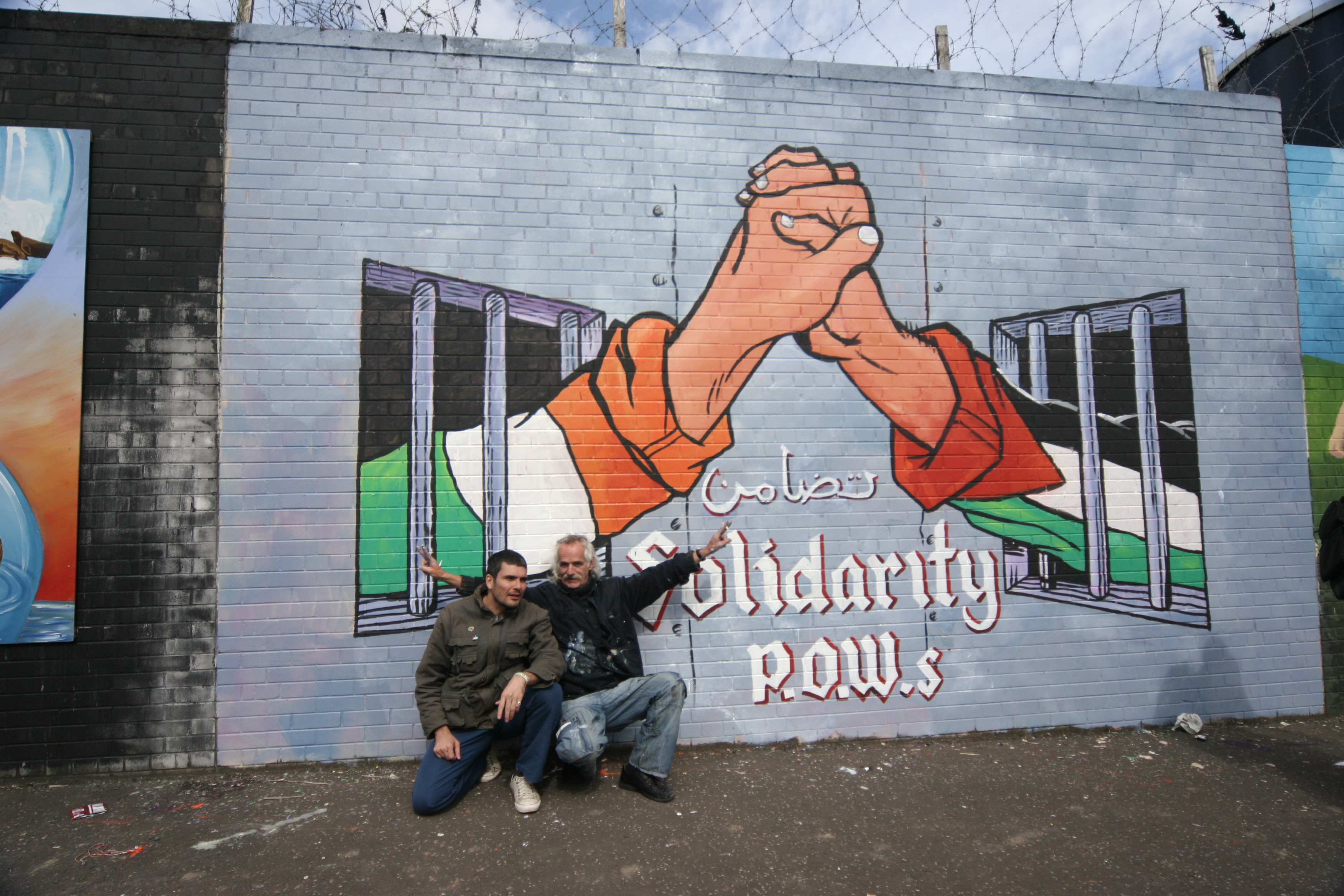
We also stopped at murals depicting South Africa’s fight against apartheid, and several representing solidarity with the Palestinian people. The Catholic leaders had decided early on that their fight against violent racism in Northern Ireland was part of something much bigger, the campaign for universal human rights. 


The End the New Jim Crow Action Network (ENJAN) began with a similar point of view. One of our first events was the movie, “Hip Hop Is Bigger Than the Occupation,” a documentary of young, black musicians touring the West Bank. Afterwards, several Hip Hop artists talked about how visiting Palestine helped them understand racism in America. Another event, a two day workshop on discrimination and the criminal justice system, featured Taha, a Palestinian who had been tortured as a teenager in an Israeli prison. Later, ENJAN decided to support the Two Row Wampum Campaign, a Native American canoe and horseback journey down the Hudson River to the United Nations. I remember Modele Clarke kingston speaking about slavery at their encampment in Saugerties. Tribal leaders, in turn, expressed solidarity with black Americans’ quest for social justice, drawing parallels to their own history of racial oppression. 

I was surprised and saddened to hear that some people in ENJAN now believe that the group should follow a much narrower path, rejecting even the mention of other events in the Mid Hudson area that promote human rights. Josh Ruebner, Outreach Coordinator of US Campaign to End the Occupation, spoke in Woodstock about the oppression of Palestinians and American’s history of racism. Of course, End the Occupation’s significant involvement in the Ferguson rallies for African American rights came up often in his talk. Are allies like this to be silenced or pushed away? End the Occupation has 400 member groups all across this country. These groups all see their connection to ENJAN’s fight against racism. Why can’t we see it?

In truth, anyone promoting justice for some, but denying it for others, doesn’t really believe in human rights. Often, they are just protecting the oppressor by deflecting attention from gross human rights violations committed somewhere else in the world. Like Israel’s recent slaughter of 500 Palestinian children in Gaza. 

So read about End the Occupation’s work in Ferguson this fall. Then tell the group that we don’t need allies like this because they are only a distraction. 

Fred Nagel

===========

Deeply Humbling and Inspiring...

This month, the US Campaign was honored to help bring together a strong Palestine Contingent to the Ferguson October Weekend of Resistance to join a movement moment challenging the national epidemic of racial profiling and police militarization, brutality, and impunity. We know that we cannot advocate an end to Israeli state violence while ignoring state violence against communities of color here at home, as part of our commitment to confronting racism and bigotry in all its forms.

The weekend was a phenomenal success with countless unforgettable moments including: Contingent members joined more than a dozen acts of civil disobedience, shutting down St. Louis City Hall, blocking the doors to a fundraiser for local complicit politicians, taking part in a shopping mall flash mob and the people's occupation of St. Louis University, shutting down three Walmarts (in solidarity with recent police victim John Crawford), and much more.

A diverse group of more than 100 joined a national march of thousands holding signs saying, "From Palestine to Ferguson": "Resistance Is Not a Crime," "End Racism Now," and "Justice for All." The march culminated in a rally where St. Louis Palestine Solidarity Committee (PSC) and US Palestinian Community Network (USPCN) member Suhad Khatib and Palestinian-American Dream Defenders organizer Ahmed Abuznaid spoke eloquently of the importance of joint struggle, bringing tears to many eyes.

Palestinian poet Remi Kanazi performed at the Hip Hop and Resistance concert along with Dead Prez, Talib Kweli, Tef Poe, and others.

PSC members Suhad Khatib, Hedy Epstein, and US Campaign Steering Committee member Sandra Tamari joined Kanazi on stage with Civil Rights leader Dr. Cornel West for a dynamic panel. When local Ferguson youth took to the stage asking to be heard, Khatib and Tamari immediately ceded their spots in solidarity.

Contingent members stood with courageous St. Louis and Ferguson community members to challenge the local militarized police presence in the streets night after night. USPCN member Zena Ozeir and PSC member Bassem Masri were arrested along with more than a hundred others. Ozeir and Masri are both safely home.

Day after day, Palestinians sent photos from across the globe to show their solidarity with Ferguson.

Even more moving than the presence of the Palestine contingent, however, was the breathtaking, spontaneous outpouring of solidarity shown to the contingent by the people of St. Louis, Ferguson, and the broader movement for justice for Mike Brown. Ferguson youth took to the rally stage and thanked the people of Palestine for being the first to send their support through tweets after Mike's killing. Dr. Cornel West decried the Israeli occupation of Palestine, which was met by deafening cheers from the crowd of thousands. These and countless other moments of connectedness and solidarity throughout the weekend were deeply humbling and spoke to our collective power when we work together for justice for all.

The US Campaign was proud to organize the contingent with an extraordinary coalition of member organizations and allies made up of the PSC, Organization for Black Struggle, USPCN, Muslims for Ferguson, Council on American Islamic Relations - St. Louis, Palestinian BDS National Committee, National Students for Justice in Palestine, Palestinian Youth Movement (PYM), American Muslims for Palestine, and African Americans for Justice in the Middle East and North Africa.

Be sure to check out these amazing recordings, images, and resources from the contingent:


The struggle continues - in Ferguson, St. Louis, across the nation, and across the globe. In the words of Ferguson youth: "United we stand, divided we fall." Let's stand together when it counts to build a better world for all.

Onward,

Anna Baltzer

National Organizer
St. Louis, Missouri

"Climate of fear" at Vassar College


Amid ‘climate of fear’ at Vassar, president comes out against ‘action and protest’ re Israel

Israel/Palestin
 on  104 Comments

Three weeks ago I did a piece on tensions at Vassar College over a class trip to Israel and Palestine whose itinerary struck many as oblivious of the occupation. The Students for Justice in Palestine chapter picketed the class in February, and a month later the college held an angry forum over that protest. People on both sides said they felt bullied. Days after that, the students left on their trip.
My piece got wide circulation because it said that the conflict was coming to the U.S. And truly, the issue continues to roil the campus.
In the last few days two pieces have been published at Vassar that suggest to me that the pro-Israel side of the discussion is winning: Vassar officials are characterizing angry protest of the trip and Israel as illegitimate.
One is a piece in the college paper by the two professors who led the trip, reporting on it and openly identifying themselves as supportive of Israel. They say that “a climate of fear has descended on campus.”
But before I get to that, more important is a statement by Vassar President Catharine Hill yesterday that takes the professors’ side. Hill seems fearful about the issue upending the campus. She celebrates the student trip to “Israel and the West Bank” and urges students to have civilized disagreement over Israel and Palestine, and not resort to “action and protest,” but “discussion.”
I have heard from many of you, on campus as well as alumnae/i and parents, who are concerned, as am I, about campus tensions stemming from different viewpoints about Israel and Palestine. I know that people have very deep feelings about these issues and emotions can be raw….
Some people will argue that action and protest are the only way to effect change at a particular moment in time at a particular place, that discussion will have little impact. At times that has and certainly will be true. But at Vassar our greatest strength is in the power of argument and reason….
We need to treat each other civilly and with respect.  If we don’t, we shut down and shut out important voices. People may then withdraw from the discussion. This is a loss of ideas and perspectives.
In offering “model” discussions of the conflict, Hill pointedly leaves out the tense March 3 meeting I attended and reported on. So a heated meeting about an important issue in which people say they feel intimidated should not take place at Vassar. Hill urges polite debate:
There also have been campus lectures on various sides of the issues related to Israel and Palestine in the past few weeks that happened with respectful disagreement but without disruptive conflict.
This is the part where Hill embraces the trip. No reference to Palestine.
Our International Studies course, the Jordan River Watershed, that included a recent trip to Israel and the West Bank, provided an opportunity for deep engagement and learning around some of the most contentious issues of our time. While there were and continue to be discussions on campus about what kinds of trips take place, I have been moved by comments from the students and faculty who made this trip. Instead of the monolithic opinions some expected to encounter among many in both areas, they found instead a range of viewpoints. Our students and faculty witnessed diverse groups working through intense, difficult discussions to find some understanding and even common ground. There can be no better learning experience. I hope that difficult conversations on campus can have the same impact on our students’ lives.
As I said, the two professors who led the trip have published a report on it, in the college paper. Rachel Friedman and Jill Schneiderman decry the protest against their class for casting them as privileged and allegedly racializing the issue. They also accuse the critics of sexism without explanation (I believe the reason is that the forum I attended was led by two men, and Schneiderman and Friedman felt they were its targets).
Interestingly, the professors say they come out of Jewish communities that are supportive of Israel (if also critical).
Excerpts of their article in The Miscellany News:
 We have, of course, followed the maelstrom of reactions to the trip. We, as the instructors of the trip, have personally been attacked from both left and right. In one account, we are “white settler colonialists” oppressing the Palestinians; in the other, we are “self-hating Jews” pursuing an “anti-Israel agenda.” In fact, people who made little, if any effort to examine the details of our course subject and itinerary have reduced us to stereotypical caricatures. If their narrative is that the two of us are bent on destroying Israel, it is because our support for many of the goals of Students for Justice In Palestine (SJP) and the Open Hillel movement seems irreconcilable with our involvement in our Jewish communities and support (albeit critical) of Israel. If their narrative is that we support a white colonialist regime in Israel, then perhaps they refuse to look at the ways in which we are committed to fighting injustice against Palestinians. Though unsurprised by these reactions, they sadden us, particularly as educators….
One especially vexing aspect of the criticism leveled at us is that it has been racialized. In early February, SJP students picketed our course causing some of our students to express feelings of harassment and intimidation upon entering the space of the classroom. We objected to the picket because of its negative effect on those who already felt beleaguered by ill-informed criticisms across campus for enrolling in the course.Discussing the picket during class, our students asked us to relay to administrators in the Dean of the College office and the International Studies program the request for a facilitated discussion between them and SJP members. Despite our repeated requests for such an intervention, none transpired.
Since then, our objection to the picket has been characterized by some members of the Vassar community as our use of white privilege to target students of color. If we and our students had been consulted before this conclusion was drawn, listeners would have learned that our students—many of whom belong to racial and ethnic minority groups—were as surprised as we were that the group of SJP protesters were characterized as being “of color.” Furthermore, it would have become clear that we supported the right of SJP students to protest in any number of ways, including ongoing tabling in the College Center, but not inside an academic building at our classroom door….
Many Vassar students and faculty have expressed their concern that over the last several years, a climate of fear has descended on campus. This fear was confirmed for them during the spectacle at the Open Forum that was held on March 3.
In our opinion, the rage unleashed disrespectfully at us at the forum has a gendered as well as a racial dimension.
I return to my original piece: the conflict is coming to the United States, and as it heats up, Catharine Hill’s hope for civil disagreement will be beside the point. Katie Miranda addressed that argument in a cartoon at our site, “Both Sides.” It compares the demands for civil dialogue on U.S. campuses with the oppression of Palestinians in our name. That’s why I think rage is inevitable, and maybe necessary. As Hill states herself sometimes action and protest are necessary. Why not in this case? We are talking about an intractable conflict that is intractable in some large measure because the U.S. government and liberal institutions and the official Jewish community are standing with an occupier that has created Jim Crow conditions for nearly 50 years (as countless northern institutions sided with the slave power in the 1850s). We have seen again and again that dialogue doesn’t affect the power arrangements one iota; it only allows supporters of the occupier to feel that they have atoned (we are critical too!) without doing a thing to address the structural inequity.
Thanks to Annie Robbins. 
 http://mondoweiss.net/2014/04/president-against-protest#sthash.0IfnjTo8.dpuf